Backflow prevention
RPZ and double-check devices: DEP-approved plan, installation, the yearly test, the report to DEP.
Sizing, tank or tankless, venting, recirculation, mixing valves. Homes and commercial.
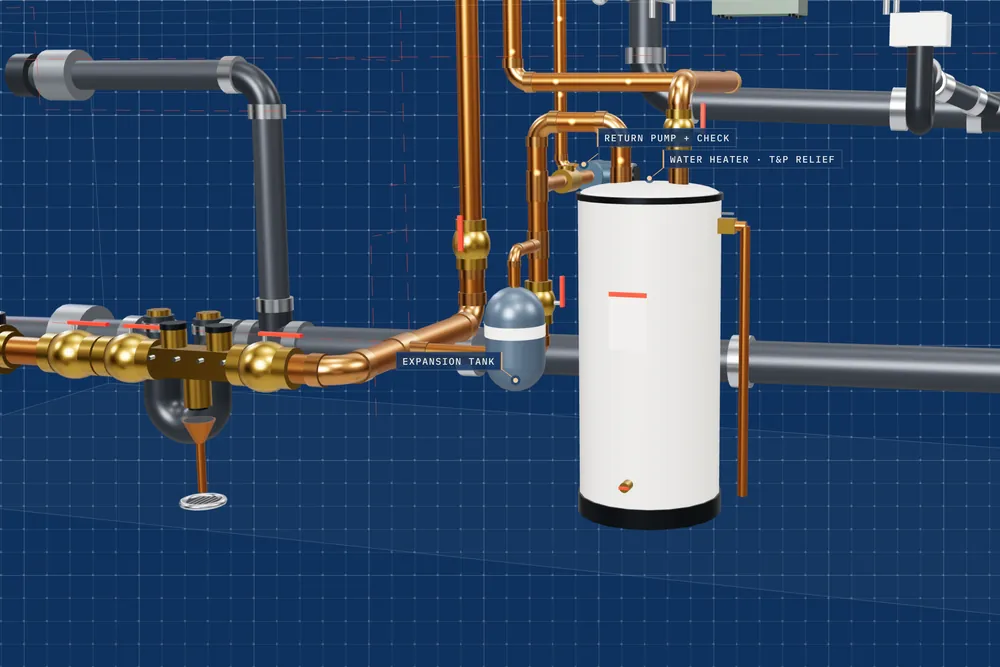
01 · The problem
An undersized heater runs out at the dinner rush. An oversized one short-cycles and dies early. A recirculation loop without a check valve heats the cold line. The failures are all design failures.
02 · The system
Sizing from the fixture count and the recovery the building actually needs. Venting per the appliance listing. Thermostatic mixing where the code requires it. Dielectric unions where copper meets steel.
03 · The fix
Heater set, piped and vented; power and fuel hookups listed in the scope, so nobody assumes the other trade has them. Recirculation pump and check valve. Expansion tank on the cold supply wherever a check valve, pressure-reducing valve or backflow preventer feeds the heater (NYC Plumbing Code 607.3). Relief line full size through an air gap, ending within 6 inches of the floor (504.6). Tested, documented.
Fixture count, peak demand and the recovery the building actually needs. A restaurant dish machine and a two-bath apartment do not get the same tank, and a replacement is sized again, not copied.
The appliance listing decides the venting; the fuel decides the hookup. Fuel and power connections are listed in the scope so no trade assumes the other one has them.
Expansion tank on the cold supply wherever a check valve, pressure-reducing valve or backflow preventer feeds the heater (NYC Plumbing Code 607.3). Thermostatic mixing valve where the code requires it. Dielectric unions where copper meets steel. Recirculation pump with a check valve so the loop cannot heat the cold line.
The temperature and pressure relief valve discharges full size through an air gap and ends within 6 inches of the floor, open (NYC Plumbing Code 504.6). A drain pan with its own drain where a leak would damage the space below.
Set, piped, vented, filled, fired and checked at every connection. The settings and the test go in writing.
The tank is the cheap part. What the code and the building hang on it is what decides whether it lasts: expansion tank, relief line, mixing valve, return loop, pan.
The drawing scrolls sideways on a phone. The numbers are explained below.
A full-port valve on the cold inlet so the heater can be isolated without shutting the building. Cold enters at the top and reaches the bottom of the tank through the dip tube.
On the cold side, close to the heater. Wherever a check valve, pressure-reducing valve or backflow preventer closes the system, heated water has nowhere to expand; the tank takes it (NYC Plumbing Code 607.3). Without one the relief valve weeps and the tank fatigues.
Where copper meets the steel tank nipples. Two metals in water make a battery; the union breaks the circuit so the nipple does not corrode through in three years.
In the tank opening the manufacturer provides, within 6 inches of the top. It opens at 150 psi or 210 degrees F, whichever comes first. The one safety device on the heater, and the one most often found capped or missing.
Full size, no valve, no threads on the end, downhill, through an air gap, ending within 6 inches of the floor (NYC Plumbing Code 504.6). A discharge that runs uphill or ends behind the tank hides the very leak it exists to show.
Out the top, with a heat trap, to the building. Insulated from the tank to the fixtures where it runs exposed.
The tank can store water hot enough to control bacteria while the valve blends it down to a safe fixture temperature. The code requires one where the delivered temperature has to be limited; a bath or shower gets its own pressure-balance or thermostatic valve on top of this.
In a building with a long run, the loop keeps hot water at the fixtures. The pump moves it; the check valve stops the loop from pushing hot water backwards into the cold line, which is the usual cause of a cold tap that runs warm.
A pan under the heater with its own drain to a floor drain or an indirect receptor wherever a leak would damage the space below. The tank drain valve at the bottom is for flushing sediment and for the day the heater comes out.
Per the appliance listing: atmospheric through a draft hood, power vented, or direct vented. The vent, the combustion air and the clearances are checked against the manual, not against what the old heater had.
Fuel and power hookups are listed in the scope so no trade assumes the other has them. Gas appears here only as a connection on the schedule.
New York City: Brooklyn, Queens, Manhattan, the Bronx and Staten Island. PlumbHub LLC manages plumbing and fire protection projects. Licensed plumbing and sprinkler work in New York City is contracted, performed, filed and signed off by the New York City Licensed Master Plumber or Licensed Master Fire Suppression Piping Contractor engaged for each project, chosen to fit the job.
Because something now closes the system: a backflow preventer, a pressure-reducing valve or a check valve on the service. Heated water expands; with no open path back to the main the pressure climbs until the relief valve weeps. The expansion tank takes that volume. NYC Plumbing Code 607.3 requires it in a closed system.
Tankless suits a steady, modest demand and a building with the gas and venting for it; a tank suits a peak (the dinner rush, three showers at once) and a simpler install. The fixture count and the fuel decide it, not the brochure.
So a discharge cannot scald anyone standing next to the heater and so a leak is seen. It runs full size, with no valve and no threads on the open end, through an air gap to within 6 inches of the floor, as NYC Plumbing Code 504.6 lays out.
RPZ and double-check devices: DEP-approved plan, installation, the yearly test, the report to DEP.
Leaks, valves, toilets, faucets, low pressure, burst pipes. Found, then fixed.
Failed galvanized, old stacks, corroded risers. Replaced in phases in occupied buildings.
Call or text with the symptom, or send photos and the layout for an estimate.