Drain & sewer
Camera inspection first. Then jetting, cable or repair: whichever the pipe needs.
Leaks, valves, toilets, faucets, low pressure, burst pipes. Found, then fixed.
01 · The problem
A drip under the sink is rarely the sink. A toilet that runs is a part that costs less than the water it wastes. Low pressure has a cause you can measure: a half-closed valve, a failed regulator, scaled galvanized pipe, an undersized line. Guessing at it is how a job gets done three times.
02 · The system
Find the cause before touching the symptom: pressure read at the fixture, the valve checked, the pipe behind it looked at. Then one repair, with the right part, and a shutoff valve that works for the next time.
03 · The fix
Repaired with the proper fitting and material, not a patch. Supply stops and angle valves replaced while the wall is open. You get told what was wrong and what was done.
Where it leaks, when it started, what else changed. A drip that shows up at 6 am is a different pipe from one that shows up after the dishwasher runs.
Pressure read at the fixture and at the hose bib, static and flowing. The valve checked. The pipe behind the fixture looked at, with a camera where it cannot be reached. Guessing is how a job gets done three times.
A cartridge, a fill valve, a supply stop, a section of pipe: replaced with the proper fitting and material, not a patch or a clamp.
Supply stops and angle valves are replaced while the wall is open, so the next repair is a one-fixture shutdown. You are told what was wrong and what was done.
The parts that fail in a bathroom, and the two measurements that say why the pressure is low before anyone opens a wall.
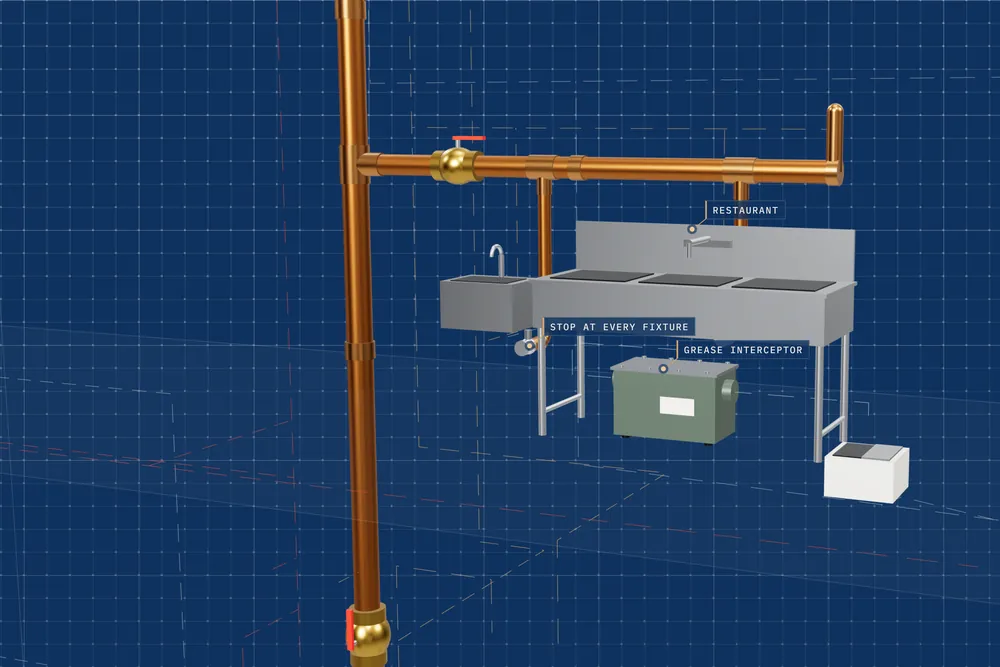
The drawing scrolls sideways on a phone. The numbers are explained below.
The valve under every fixture. Half of them in an older apartment are frozen or weep at the stem; a stop that does not close turns a faucet repair into a building shutdown, so it is replaced first.
The nut and ferrule where the supply meets the stop. Overtightened or reused, they drip a drop a minute into the cabinet floor. The ferrule is replaced, never reused.
Braided stainless with the right ends for the faucet and the stop. The old chrome risers and the rubber hoses are the ones that burst on a Sunday.
A faucet that drips or will not shut off is a cartridge or a seat, not a faucet. The part is matched to the maker; a universal part is a second visit.
Three joints on a P-trap and a tailpiece. Washers harden, nuts crack, and the leak shows only when the sink drains. Tested full before the cabinet doors close.
Inside the tank, it refills after the flush and shuts off at the water line. When it does not, the overflow tube takes the excess and the toilet runs on its own.
The seal at the bottom of the tank. Worn, warped or sitting on a rough seat, it lets water into the bowl all day: the phantom flush. The cheapest part in the house and the one that wastes the most water.
Galvanized steel closes from the inside. A 3/4 inch branch after forty years carries water through a hole the size of a pencil; cleaning does not reopen it. The fix is new pipe, from the valve to the fixture.
A gauge on a hose bib or the washing machine valve: static first, then with a fixture running. A high static and a big drop under flow means a restriction (a half-closed valve, scale, an undersized line). Low static means the supply or the regulator.
Where the static pressure is above 80 psi, NYC Plumbing Code 604.8 calls for a pressure-reducing valve on the service. A failed one gives the building either hammer and leaks, or a trickle.
One repair with the right part, the cause written down, the stop that works for next time.
New York City: Brooklyn, Queens, Manhattan, the Bronx and Staten Island. PlumbHub LLC manages plumbing and fire protection projects. Licensed plumbing and sprinkler work in New York City is contracted, performed, filed and signed off by the New York City Licensed Master Plumber or Licensed Master Fire Suppression Piping Contractor engaged for each project, chosen to fit the job.
A gauge answers it in a minute. Static pressure at a hose bib or a washing machine valve, then pressure while a fixture runs. A big drop under flow points at a restriction: a half-closed valve, a scaled galvanized branch, a failed pressure-reducing valve. If the static reading is above 80 psi, NYC Plumbing Code 604.8 calls for a pressure-reducing valve, which is a different fix.
Yes, because the cabinet floor, the wall behind it and the ceiling below are paying for it every day. Close the stop under the sink if it holds; if the stop itself is the leak, that is the first thing replaced.
Nine times out of ten a flapper that no longer seals or a fill valve that does not shut off; the tenth is a cracked overflow tube. The parts cost less than the water they waste in a month, and all three are a one-visit repair.
Camera inspection first. Then jetting, cable or repair: whichever the pipe needs.
Renovation rough-in and trim-out: new layouts, valves, drains, fixtures, appliances.
Failed galvanized, old stacks, corroded risers. Replaced in phases in occupied buildings.
Call or text with the symptom, or send photos and the layout for an estimate.