Water heaters & hot water
Sizing, tank or tankless, venting, recirculation, mixing valves. Homes and commercial.
RPZ and double-check devices: DEP-approved plan, installation, the yearly test, the report to DEP.
01 · The problem
A boiler fill with treatment chemicals, a kitchen with chemical dispensers, an irrigation line: any of them can push or pull dirty water back toward the city main when the pressure changes. DEP orders a device where the hazard calls for one, mails a reminder when the yearly test is due, and can fine the owner or shut off the water service when a test is missed.
02 · The system
The device follows the hazard: RPZ for high hazard, double check (DCVA) for low hazard. Vacuum breakers protect single fixtures and hose connections; DEP does not accept them as the main device. Sized to the service, set where it can be tested and drained, the RPZ relief discharging through an air gap to a drain sized for full flow.
03 · The fix
The device is picked by hazard. A PE or RA draws the plan and DEP approves it. The device is installed, tested by a New York State-certified tester, and the report goes to DEP within 30 days. Then the same test every 12 months. Failed devices are rebuilt with the manufacturer kit or replaced.
What the water feeds decides the device: a boiler with treatment, a kitchen with chemical dispensers, irrigation, a fire line. The survey of a building that does not know what it has comes first.
A PE or RA draws the backflow plan: device, size, location, the drain for the relief. DEP approves it before anything is installed.
Set where it can be tested and drained, the relief through an air gap to a drain sized for full flow, the test cocks reachable. Expansion tank downstream where a water heater sits behind the device.
A New York State certified tester tests the device within 30 days of installation and once a year after that. The report goes to DEP each time. A failed device is rebuilt with the manufacturer kit or replaced.
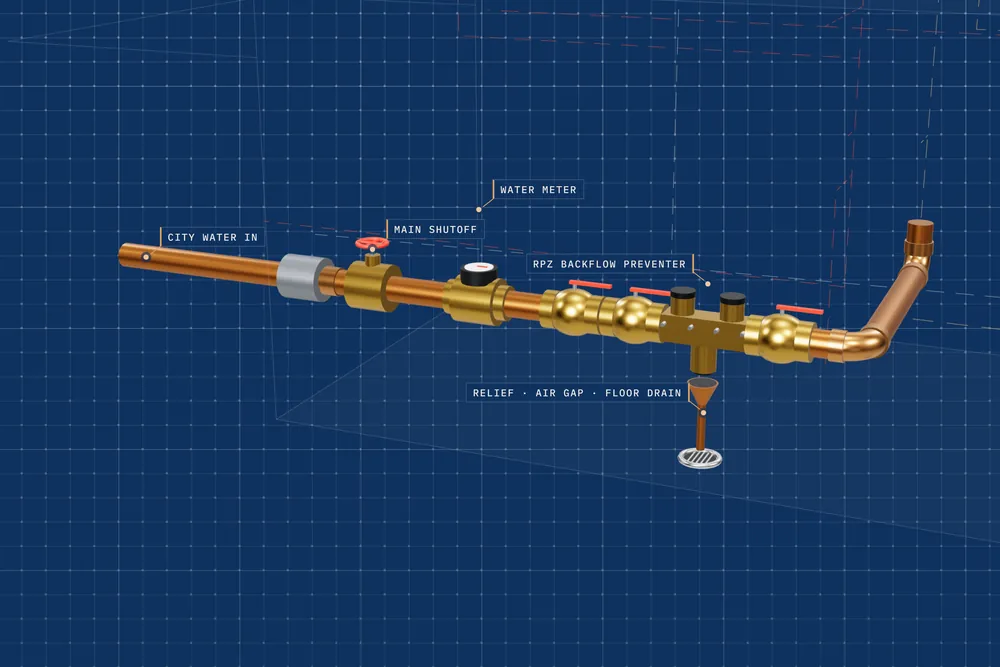
An RPZ assembly where the water service enters the cellar: shutoff, meter, the device with its two checks and relief valve, the air gap to a floor drain.
The drawing scrolls sideways on a phone. The numbers are explained below.
The building valve on the service, inside the front wall. Everything downstream can be isolated here for the installation and the yearly test.
DEP meter ahead of the device. The RPZ protects the city main from the building, so it sits after the meter and before the first branch.
The first shutoff of the assembly. Four test cocks along the device are what the certified tester connects the gauge to; without them the device cannot be tested.
Holds the building water back when the street pressure drops. Spring-loaded, so it closes before flow can reverse.
Between the two checks the pressure is held lower than the supply. If either check leaks, the relief valve opens and dumps water instead of letting it reach the main. A dripping relief port is the device doing its job and telling you a check needs a rebuild kit.
The relief can discharge at full service flow. It falls through an air gap into a drain sized for that flow; piping it tight to a drain would be a cross-connection of its own.
The backup. Two checks and a relief are what make the device acceptable for high hazard: boiler feeds with treatment, kitchen chemical dispensers, irrigation.
The downstream shutoff closes the zone for the test. From here the water goes on to the building.
Every device carries its test record. The initial test within 30 days of installation and the test every 12 months after it are done by a New York State certified tester, and the report goes to DEP.
Set above the floor, with room to read the gauges, reach the test cocks and let the relief drain. A device in a crawl space nobody can reach fails its next test by default.
Device choice follows the hazard: RPZ for high hazard, double check (DCVA) for low hazard. DEP approves the plan drawn by a PE or RA before the device goes in.
New York City: Brooklyn, Queens, Manhattan, the Bronx and Staten Island. PlumbHub LLC manages plumbing and fire protection projects. Licensed plumbing and sprinkler work in New York City is contracted, performed, filed and signed off by the New York City Licensed Master Plumber or Licensed Master Fire Suppression Piping Contractor engaged for each project, chosen to fit the job.
How the DEP backflow process works
DEP mails a reminder when the yearly test is due and a notice when a device is required. Missed tests lead to fines and, in the end, to the water service being shut off. The letter also says which hazard DEP has on file, which is where the plan starts.
An RPZ (reduced pressure zone) protects against high hazard: anything that could make someone sick. A double check (DCVA) covers low hazard. Vacuum breakers protect single fixtures and hose connections; DEP does not accept them as the main device. On fire lines the same two come as detector assemblies, DCDA and RPDA.
A small drip when the street pressure swings is normal. A steady drip means one of the checks is fouled or worn; the device is doing what it was built for, dumping water instead of letting it back to the main. A rebuild kit at the next visit usually ends it.
Sizing, tank or tankless, venting, recirculation, mixing valves. Homes and commercial.
Heads and mains for fit-outs, heads moved for apartment renovation, fire services. From the drawings to the DOB sign-off.
Restaurants, retail, offices, medical. Demolition to close-out under a GC schedule.
Call or text with the symptom, or send photos and the layout for an estimate.