Repairs & leaks
Leaks, valves, toilets, faucets, low pressure, burst pipes. Found, then fixed.
Camera inspection first. Then jetting, cable or repair: whichever the pipe needs.
01 · The problem
A clog is a symptom. Grease, scale, a belly in the line, roots at a joint, a broken hub: each one needs a different tool, and clearing it the wrong way just books the next call.
02 · The system
Camera first. We look at the inside of the pipe, measure the distance to the problem and show you the recording before anyone opens a wall or a floor.
03 · The fix
Hydro jetting for grease and scale, cable for roots and solids, spot repair or replacement where the pipe is gone. The recording says what was wrong and the invoice says what was done.
The camera goes in at a cleanout and the recording shows the inside of the pipe: grease, scale, a belly, roots at a joint, a broken hub. The distance to the problem is measured, so nobody opens a floor on a guess.
Hydro jetting for grease and scale, a cable for roots and solids, a spot repair where a section is gone, replacement where the pipe is. Clearing a broken pipe with a cable just books the next call.
A cleanout at the base of the stack, at the house trap and at changes of direction. The next inspection takes an hour instead of a day.
The recording before and after, what was found, what was done. For restaurants and buildings, a maintenance interval set from what the pipe showed, not from a brochure.
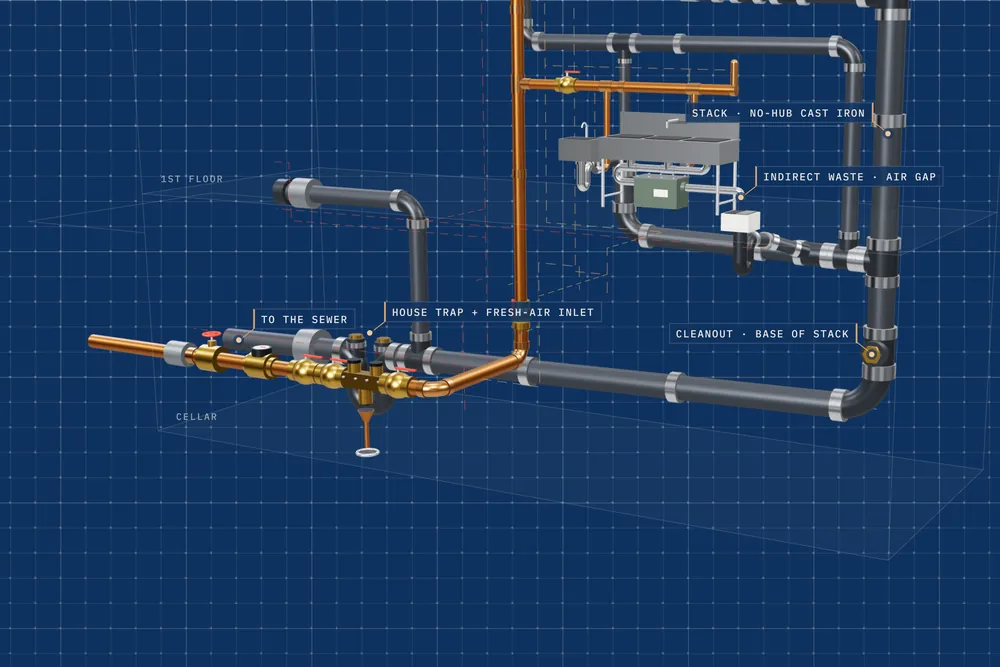
A section through the front of a New York City cellar. Everything the camera looks at, in the order the water flows.
The drawing scrolls sideways on a phone. The numbers are explained below.
The vertical line that collects every floor. The cleanout at its base is where a camera or a cable goes in; the base of the stack is also where the heaviest fitting takes the most wear.
Under the cellar slab, falling toward the street at a quarter inch per foot for pipe of 2-1/2 inches and smaller, an eighth for 3 to 6 inch (NYC Plumbing Code Table 704.1). Too little slope and solids settle; too much and the water outruns them. A belly in the run shows on the camera as standing water.
A flap that closes when the sewer surcharges. NYC Plumbing Code 715 calls for one on the drains of fixtures that sit below the nearest upstream manhole cover in the street, and only on those, so the rest of the building keeps draining.
The U at the front wall that keeps sewer gas out of the building. It is the lowest point of the system, so grease and grit settle there; the two cleanouts on top are what make it serviceable without breaking the floor.
A vent off the building side of the house trap, run up and out through the front wall to a grille above grade. It lets air in behind the trap so the water seals on the fixtures upstairs are not pulled out when a big load goes by.
From the street side of the trap, through the wall, down to the city main. The joint at the wall and the run under the sidewalk are where roots and settlement do their work.
The city main under the street. A repair stops at the property line unless the drawings and the DEP permit say otherwise; the camera tells you which side of the line the problem is on.
Trapped, and primed if nothing runs into it often, or the seal evaporates and the cellar smells like the sewer. On its own branch to the drain, with the backwater valve where the elevations call for one.
In at the cleanout, out with a recording and a footage count to the problem. The recording says grease, scale, roots, offset joint or broken pipe, and the distance says where to open the floor if it comes to that.
Jetting for grease and scale, a cable for roots and solids, a spot repair where a section is gone. The tool follows the picture, not the other way around.
New York City: Brooklyn, Queens, Manhattan, the Bronx and Staten Island. PlumbHub LLC manages plumbing and fire protection projects. Licensed plumbing and sprinkler work in New York City is contracted, performed, filed and signed off by the New York City Licensed Master Plumber or Licensed Master Fire Suppression Piping Contractor engaged for each project, chosen to fit the job.
The house trap is the U-shaped fitting at the front wall where the building drain meets the sewer; New York City buildings have one, with a fresh-air inlet on its building side. It is also the lowest point in the system, so grease and solids settle there. Two cleanouts on the trap are what make it serviceable; a trap without them gets replaced when it fails.
Jetting cuts grease and scale off the pipe wall with water; a cable punches through roots and solids. On a cast iron line with years of scale, a cable makes a hole through the blockage and the pipe is tight again in a month. The camera says which one the line needs.
Where fixtures sit below the level of the nearest upstream manhole cover in the street, a surcharge in the sewer pushes back up into them; NYC Plumbing Code 715 calls for a backwater valve on the drains serving those fixtures, and only those. The camera inspection and the elevations say whether your cellar fixtures are in that position.
Leaks, valves, toilets, faucets, low pressure, burst pipes. Found, then fixed.
Failed galvanized, old stacks, corroded risers. Replaced in phases in occupied buildings.
Renovation rough-in and trim-out: new layouts, valves, drains, fixtures, appliances.
Call or text with the symptom, or send photos and the layout for an estimate.